Covid-19 Vaccines “101”
Although the vaccination effort has been underway for some months in many countries, there continues to be lively debate around many issues including vaccine passports, inoculation of children, mandatory vaccination and variants. Earlier posts, here and here, have explored some of these issues.
However, it isn’t always easy to find comprehensive information on the vaccines themselves and this post is firmly focused on the mechanics of various options, based on information made available by vaccine manufacturers, health agencies and medical experts. It is always advisable to do your own research and there are sources referenced throughout that could be a good starting point!
Overview
There are currently two kinds of vaccine “technology” that have received emergency approval (or conditional marketing authorisation, as termed by the European Medicines Agency) by the European Union for adults: MRNA vaccines (Pfizer and Moderna) and viral vector vaccines (Astrazeneca and Johnson & Johnson). These vaccines trigger the body to create a part of the Covid-19 virus, known as the “spike protein”. The body recognises this protein as a foreigner and develops immunity, which should then jump into action in the event of a Covid-19 infection. The Russian-developed vaccine, Sputnik V, is also a viral vector vaccine.
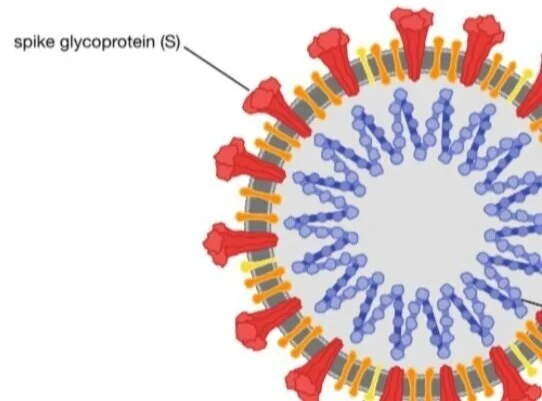
Source: Britannica Encyclopaedia
Other kinds of vaccine technology involve the direct injection of a weakened virus or part of it into individuals, which will trigger an immune response – in such cases the body is not prompted into creating components of the virus itself. The concept of injecting whole, or portions of a virus to spur an immune response is considered more traditional, given that it is the approach most prior vaccines have used. The Novavax Covid-19 vaccine, a “sub-unit protein” vaccine is one such example, as is the Valneva vaccine based on a whole, inactivated Covid-19 virus - both are still in trials and their manufacturers are working towards emergency approval. There are also the Chinese-developed vaccines Sinovac and Sinopharm, which have been approved in some countries and consist of inactivated particles of Covid-19.
Proponents of the more novel vaccines explain that the target virus does not have to be isolated and replicated to manufacture large quantities of vaccine, especially in a pandemic setting. They also claim the safety benefits of not including the actual virus in their formulations, although measures are also required to render the spike proteins produced by the newer vaccines harmless. All these considerations can be weighed against the longer safety profile of more traditional vaccines.
MRNA Vaccines
These contain “instructions” encoded into messenger RNA (hence the “MRNA” label) that trigger our cells to produce the Covid-19 spike protein. MRNA are a part of the body’s cells that carry codes from our DNA in the nucleus, to the sites of protein synthesis in our cells. The MRNA delivered through the Pfizer and Moderna vaccines is genetically engineered and stored and administered within a lipid-nanoparticle substance. Both Pfizer and Moderna require two doses of the vaccine.
Whilst MRNA vaccines have been studied for many years, this is the first occasion they have received approval for use on humans. They are also often considered as promising technology in the fight against cancer.
Trials
Following the outbreak of the pandemic, trials on adults were carried out before the vaccines received emergency approval from the EMA and the US Food and Drug Administration (FDA). At present, the trial study completion dates of the vaccines for adults are estimated at October 2022 for Moderna and May 2023 for Pfizer. Trials are also ongoing for use in other groups, such as children and pregnant women.
Viral Vector Vaccines
Viral vector vaccines also induce cells to create the Covid-19 spike protein but in a different way – a mild virus (the vector) which is distinct from the target virus, is used to deliver the instructions to our cells. Genetic material from the Covid-19 virus is inserted into this vector and upon vaccination, it enters our cells and provides them with instructions to produce the Covid-19 spike protein. The virus vector is made non-replicating by manufacturers, so that it does not multiply as it naturally would in the human body. The presence of the protein induces our immune systems to create antibodies and defensive white blood cells, for protection in the event of a real infection.
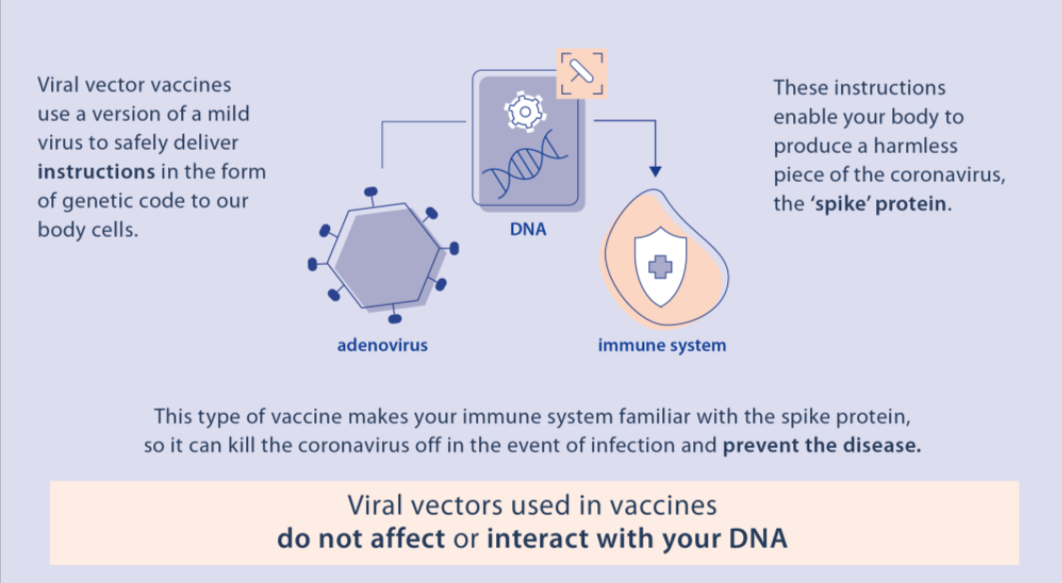
Source: European Vaccination Information Portal. Another infographic from the Portal explains that the newly created immune defence should also destroy the vaccine vectors, so they do not remain in the body.
The Astrazeneca, J&J and Sputnik V vaccines use adenoviruses, which are strains of the common cold, as a vector. Because humans are likely to have developed some immunity to adenoviruses - and that would render the vaccine less effective - manufacturers have endeavoured to use adenoviruses that would be less familiar to our immune systems. As a result, Astrazeneca uses an adenovirus common to chimpanzees, whilst J&J has used Ad26, a less common human adenovirus. Sputnik V uses the Ad26 virus in its first dose, and a more common human adenovirus, Ad5, in its second dose. J&J is a one dose vaccine, whilst Astrazeneca’s vaccine is administered in two doses.
As with the MRNA vaccines, viral vector vaccines are quite novel in wide-spread use and have been studied for years. However, in contrast with MRNA vaccines, some adenovirus vector vaccines had previously been approved for use on humans. These include marketing authorisation for J&J’s Ebola vaccine, which uses the Ad26 adenovirus and China-based CanSino Biologics’ Ebola vaccine, an Ad5 vaccine with emergency approval from China.
Trials
As with the MRNA vaccines, the adenovirus vaccines underwent initial trials on adults prior to emergency authorisation, and trials are ongoing for other groups as well. At present, the J&J trial study completion for vaccination in adults is estimated to conclude in January 2023, whilst Astrazeneca should conclude in February 2023.
Vaccine Efficacy
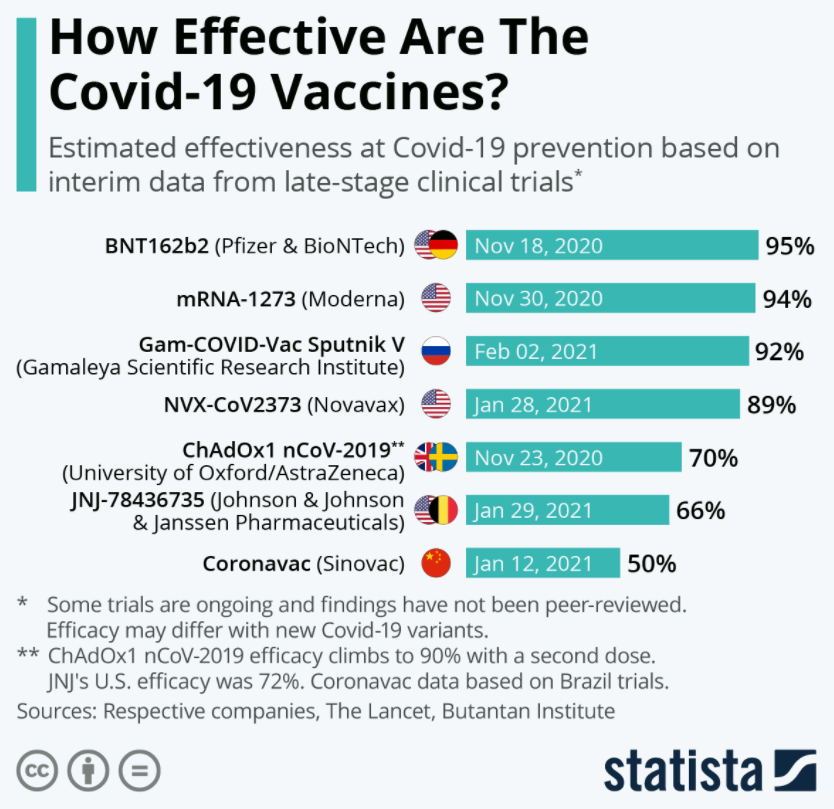
Studies suggest that vaccine recipients already achieve some immunity after one dose of a two-dose vaccine, and fuller immunity around fourteen days after receiving a shot of a single-dose vaccine, or the second shot of a double-dose vaccine. All the vaccines purport to minimise the symptoms and effects of Covid-19 infection, so that hospitalisations and deaths are dramatically reduced. In February 2021, Statista compiled the reported efficacy of vaccines “based on interim data from late stage clinical trials”, which ranged from 50% (Sinovac) to 95% (Pfizer). Statista noted the caveat that the numbers had not been peer-reviewed and that J&J proved 72% effective in a US study.
None of the vaccines in use have been shown to prevent infection altogether, meaning that vaccinated individuals are still capable of transmitting Covid-19, although ongoing monitoring suggests that transmission of Covid-19 may be reduced in the vaccinated.
This article published by Yale Medicine in June 2021 is a very helpful resource on the efficacy of vaccines, as it compares the effectiveness initially reported by the vaccine manufacturers (or the FDA in the case of J&J), against real world observation since vaccinations began.
For example, following phase 3 trials, Pfizer reported “95% efficacy in preventing COVID-19 in those without prior infection, 7 days or more after the second dose”. Subsequently “a small CDC study that enrolled 3,950 health care personnel, first responders, and other essential and frontline workers showed the vaccine to be 90% effective upon full immunization (at least 14 days after the second dose) in real-world conditions.”
Covid-19 Variants
There is a lot in the news about variants, inevitably causing anxiety and fuelling discussions around top-up vaccines and extended restrictions. As a starting point, it is normal for virus variants to emerge and once immunity to a particular virus is achieved (by infection or vaccination), the body can typically recognise and combat variants even if they are not identical to the initial virus. Therefore, there is cause for concern only when a variant is proven to be significantly more infectious and/or deadly. There is quite some debate within the medical community on the actual danger new variants pose - an incredibly helpful (and brief) write-up by the HART Group on the topic suggests there is less reason to be alarmed that one might think.
Another important point on variants is that if infection is not entirely prevented in vaccinated individuals, the virus is capable of mutating into other variants both within vaccinated and unvaccinated groups – it is rather the potential for such mutation across distinct groups (i.e. vaccinated, naturally immune and never infected individuals) which is likely to differ, and would be helpful to better understand through further study. This is another point of academic debate, with a small minority of experts (including Nobel Laureate Dr. Luc Montagnier, and virologist Dr. Geert Vanden Bossche) positing that stronger variants might actually emerge, as a result of mass vaccination during an ongoing pandemic.
Side Effects of Vaccines
Every medical intervention has potential side effects. Experts advise it is expected that vaccine recipients experience mild to moderate side-effects, such as pain/swelling at injection site, fever, chills and/or diarrhea. It is unsurprising that people are particularly sensitive to more adverse effects posed by the vaccines, given the speed of their development and deployment under pandemic conditions. Part of this speed can be attributed to the US Government’s Operation Warp Speed, which provided substantial funding to vaccine developers and cut regulatory red-tape to hasten the approval process, yet it is not unreasonable to be concerned about the side-effects of any medical intervention.
It is not yet possible to know the long-term side effects of the vaccines but there are regulatory frameworks under which known short-term effects are being reported, such as the Eudravigilance system operated by the EMA, the UK’s Yellow Card Scheme, and the VAERs database of the US Center for Disease Control (CDC). These databases only contain reported incidents and may therefore not be accurately representative of numbers, although they are certainly helpful in understanding the scope of the side-effects and which particular vaccines they are associated with.
Side-effects currently receiving the most attention from authorities include myocarditis (inflammation of the heart muscle), which the CDC states has been particularly seen in male adolescents and young adults that received the MRNA vaccines. It is reported most cases are mild, and the side-effect is also being closely studied in Israel and by the EMA. There is additionally a rare form of blood clotting associated with the adenovirus vaccines of Astrazeneca and J&J, for which German researchers claim to have found the root cause and a potential solution - J&J reached out to the researchers to discuss their findings and potential improvements to its vaccine, although it is not clear whether Astrazeneca has since done the same. Instances of clotting have also been associated with the Pfizer and Moderna vaccines.
Finally, a number of women have reported irregularities in their menstrual cycles after receiving the MRNA vaccines - this is being attributed by some doctors to the immune response caused by the vaccine and further, conclusive, research would be welcome.
As of June 7 2021, the US VAERS database had received reports of 5,208 deaths linked to the Covid-19 vaccines out of 302 million doses given (counting first and second doses separately). This is reportedly higher than total vaccine-related deaths reported across previous years, and the CDC states that: “a review of available clinical information, including death certificates, autopsy, and medical records, has not established a causal link to COVID-19 vaccines”. Adverse effects are spread over the only three vaccines (Pfizer, Moderna and J&J) currently approved for use in the US.
Authorisation
More robust data will be required by regulators to authorise the use of vaccines beyond the current emergency approvals. In particular, some experts have highlighted the need for more biodistrubution data, which tracks the distribution of a vaccine’s ingredients once injected in the body. The EMA has previously stated that such studies “are usually not required for vaccines… However, such studies might be applicable when new delivery systems are employed or when the vaccine contains novel adjuvants or excipients.” That would appear to apply to a number of the current crop of vaccines on offer. There are also questions around the further insights that can be gained from placebo groups in the adult trials, given that a number of manufacturers, such as Pfizer and Moderna, have since offered vaccines to these participants and many have accepted.
Some Helpful Sources
Different types of COVID-19 vaccines: How they work - Mayo Clinic https://www.mayoclinic.org/diseases-conditions/coronavirus/in-depth/different-types-of-covid-19-vaccines/art-20506465
Johnson & Johnson - Simplifying the Science of COVID-19: How Adenovector Vaccines Work https://www.jnj.com/our-company/simplifying-the-science-of-covid-19-how-adenovector-vaccines-work
Natural vs vaccine immunity: which is safer or more protective? https://www.hartgroup.org/natural-vs-vaccine-immunity/
Covid-19 vaccines: In the rush for regulatory approval, do we need more data? https://www.bmj.com/content/373/bmj.n1244
Vaccine Trial Information and Completion Dates https://clinicaltrials.gov/